
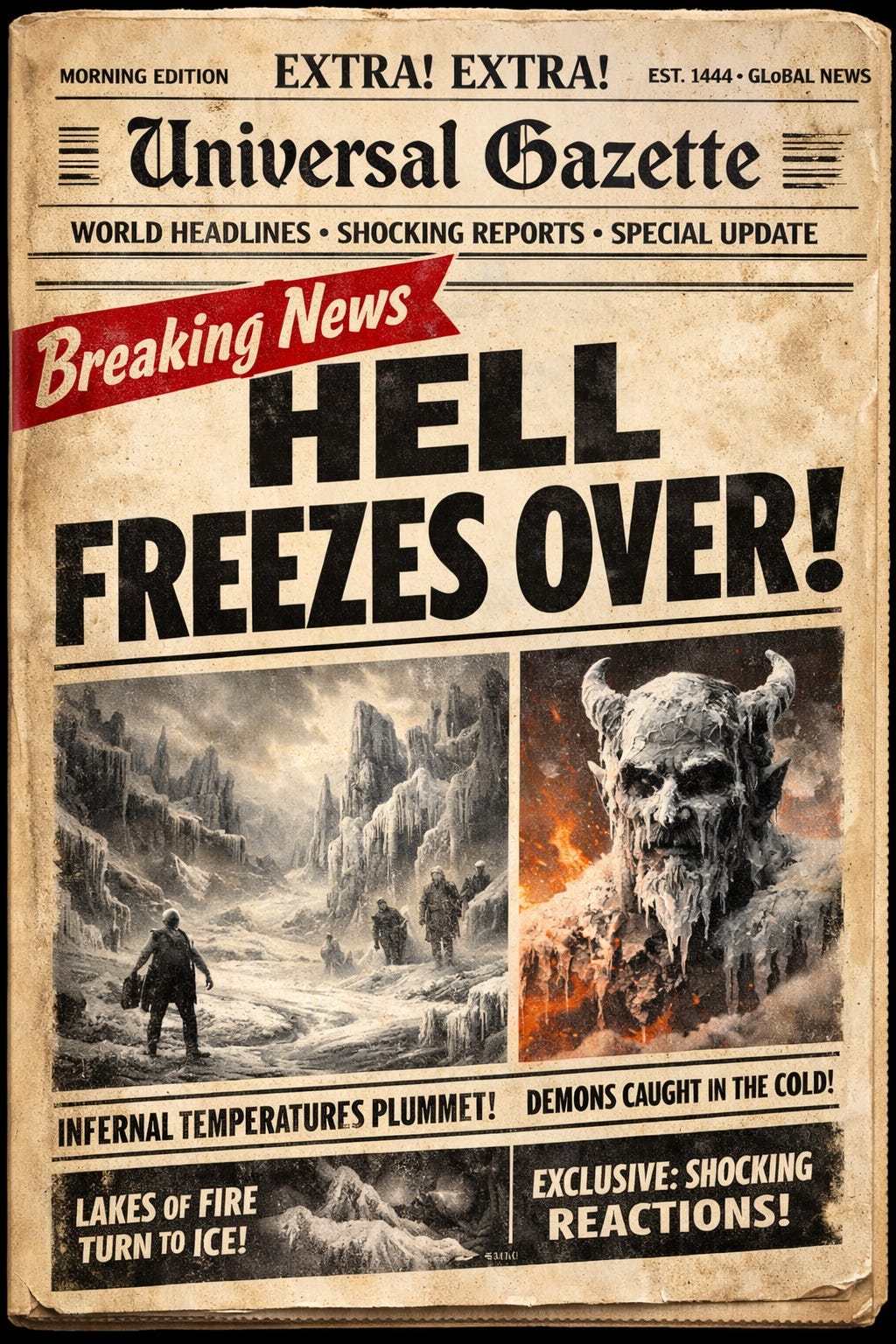
Breaking News: HELL FREEZES OVER
Read now (52 mins) | Reclaiming Your Life from a Story of Fear
Audiobook | Companion Song | Centering Practice | Circle Guide: Simple | Circle Guide: In-depth | Discussion Prompts
→ Also available on: Amazon | B&N | Kobo | All Digital Retailers
→ Free ePubs for Paid Subscribers: The Conservatory
INTRODUCTION
The Burden You Were Never Meant to Carry
There is a particular kind of suffering that hides in plain sight—
a suffering that begins not with a wound,
but with a story.
Millions grew up being told that the universe keeps a secret list of their failures,
that their desires are dangerous,
that their curiosity is rebellion,
that their doubts offend something divine.
Many were told that a single misstep—
a question, a thought, a moment of fear,
or simply being human—
could condemn them to eternity in torment.
And so a child, soft and impressionable,
learned to fear the One they were told was Love.
This handbook exists for the millions who carry that fear quietly,
even decades later—
when the rational mind says, “I don’t believe this,”
but something deeper whispers, “But what if…?”
If this is you—
know this:
you are not weak, broken, or foolish.
You were imprinted in the years when the world was still new to you,
when adults spoke with the authority of gods,
and you had no way to separate myth from manipulation.
This handbook is written with compassion for you.
For the child you were.
For the adult you became.
For the life you still deserve to live without fear.
It is not a book against religion.
It is a book against fear.
Against coercion.
Against the idea that a loving universe would ever
require terror to shape a human soul.
This handbook will not tell you what to believe.
It will simply show you—
gently, clearly, and with great reverence—
that you were never in danger.
Not then.
Not now.
Not ever.
You cannot be eternally punished
because the nature of existence does not allow it.
You cannot fall out of love
because love is the foundation of reality itself.
You cannot lose your soul
because you are the soul.
This is your invitation to step out of the story of fear
and step into your rightful life.
A life lived boldly.
Tenderly.
Honestly.
Fully.
A life in which nothing is waiting to destroy you—
and everything is waiting to embrace you.
CHAPTER 1
The Invention of Eternal Fear
Hell, as imagined today, is not ancient.
It is not universal.
It is not a fixed truth woven into the fabric of the cosmos.
It is a story—one with a long history of revision, exaggeration, and political convenience.
Early Judaism had no Hell.
The Hebrew Bible speaks of Sheol—a neutral underworld, not a place of torment.
Many Indigenous cultures knew of no eternal punishment at all;
the afterlife was simply another layer of the same web of life.
Early Christianity held a variety of views—
many of which assumed that all souls eventually returned to God.
The concept of eternal, conscious torment
grew later, slowly,
with the rise of institutional power
and the need to assert control over increasingly large populations.
A single image changed everything:
the idea that misbehavior in this brief, fragile life
could lead to infinite suffering after death.
No loving parent would create such a system.
No just universe would impose such disproportionality.
No wise spiritual teacher ever taught fear as a path to freedom.
But power structures did.
As populations grew, leaders needed simpler tools for managing them.
Fear is efficient.
It requires less explanation than wisdom.
It demands less dialogue than love.
It enforces order without the slow work of cultivating understanding.
Hell, once imagined, became useful.
And so it spread.
But usefulness is not truth.
Utility is not morality.
And fear is not wisdom.
The invention of Hell says far more about human institutions
than it does about the nature of the universe.
CHAPTER 2
How Fear Became a Tool of Power
Fear is one of the most potent human motivators.
It narrows attention, sharpens obedience,
and suppresses dissent.
Religious institutions—like governments, armies, or empires—
have historically relied on fear to maintain order.
When people fear eternal consequences,
they police themselves.
They regulate their own thoughts.
They obey more readily.
They question less boldly.
The threat of Hell served these purposes perfectly.
It turned spiritual leaders into gatekeepers of salvation.
It turned doctrine into law.
It turned questions into crimes.
It turned human beings—full of nuance, contradiction, and yearning—
into anxious subjects seeking approval from authority.
But here is the deeper tragedy:
Fear-based control does not create wise, compassionate, ethical humans.
It creates anxious, divided, self-doubting ones.
It fractures the psyche.
It splits the self into “acceptable” and “unacceptable.”
It creates guilt where there should be curiosity,
shame where there should be sensitivity,
obedience where there should be integrity.
Fear can make a person compliant,
but it cannot make them whole.
The use of fear was a strategy, not a revelation.
A choice, not a truth.
A political tool, not a spiritual necessity.
And that means fear can be unlearned.
Released.
Laid down.
You can step out of the system that shaped you
and discover who you are
when fear is no longer the architect of your behavior.
CHAPTER 3
Childhood Imprinting: The Wound We Never Asked For
A child’s mind is not built for theology.
It is built for survival.
When a child hears of Hell,
they do not interpret it metaphorically.
They absorb it somatically.
Viscerally.
As truth.
The nervous system, still forming,
learns to associate curiosity with danger,
desire with risk,
pleasure with shame,
self-expression with potential punishment.
This is not philosophy.
This is biology.
Children raised with fear of eternal punishment often develop:
• hypervigilance
• chronic guilt
• fear of making mistakes
• compulsive self-monitoring
• difficulty trusting themselves
• fear of disappointing authority
• suppression of natural desires
• moral perfectionism
The child learns:
“I must not be myself—I must be what the authority wants.”
This creates adults who appear “moral,”
but who are internally fractured:
half longing to be free,
half terrified of the consequences.
Here is the truth you were never told:
What you internalized was not your fault.
It was not a sign of weakness.
It was not a moral failing.
It was simply the natural response of a young, developing mind
to a story too heavy for a child to carry.
You can now set it down.
CHAPTER 4
The Psychology of Fear vs. The Psychology of Love
Fear and love are two different operating systems.
Fear constricts.
Love expands.
Fear tightens the muscles and narrows possibility.
Love softens the body and opens perception.
A person who lives under fear of eternal punishment is not living ethically—
they are living carefully,
cautiously,
anxiously,
always wondering if they have done enough to appease something unseen.
But genuine morality—
the kind that uplifts communities,
creates kindness,
fosters empathy,
heals conflicts—
cannot grow from fear.
It grows from relationship.
Fear says:
“If I do not behave, I will be punished.”
Love says:
“If I do not behave, someone may be hurt—and I care.”
Fear says:
“My worth is conditional.”
Love says:
“My worth is inherent.”
Fear says:
“The universe is waiting to judge me.”
Love says:
“The universe is waiting to meet me.”
Spiritual traditions all over the world have understood this:
that humans flourish when they feel safe,
not when they feel surveilled.
People become wise when they feel trusted.
They become compassionate when they feel connected.
They become responsible when they feel seen and valued.
A spirituality rooted in fear creates compliance.
A spirituality rooted in love creates transformation.
This handbook takes the position that
the universe is aligned with love, not fear—
because that is the only alignment that leads to human flourishing.
And human flourishing is a far more reliable compass
than ancient threats of imagined torment.
CHAPTER 5
What the World’s Wisdom Traditions Actually Teach About the Afterlife
The idea of a fiery, eternal Hell is not universal—
in fact, it is rare.
Judaism
No eternal Hell.
The afterlife, in traditional Judaism, is vague and neutral.
Moral focus is on this life, not punishment beyond it.
Islam
Does contain images of judgment—
but also insists on God’s infinite mercy,
and many Islamic scholars historically argued that Hell is purifying, not eternal.
The Qur’an itself emphasizes compassion far more than fire.
Hinduism
No eternal punishment.
Souls reincarnate to learn, grow, evolve.
Consequences are educational, not retributive.
Buddhism
No eternal Hell.
States of suffering exist, but they are temporary—
expressions of mind, not cosmic sentences.
Indigenous Traditions
Most Indigenous cultures know nothing of eternal torment.
The afterlife is a continuation of relationship,
a circular movement,
never a punishment without end.
Mystical Christianity
Even within Christianity, mystics like Origen, Gregory of Nyssa,
and many desert fathers taught universal reconciliation—
that every soul eventually returns to God.
The through-line, across cultures and centuries, is this:
No tradition rooted in deep wisdom
describes a universe where love ends,
mercy fails,
or punishment is infinite.
These punitive images are cultural artifacts, not cosmic architecture.
They persist not because they are true,
but because fear is persuasive.
Truth, however, is liberating—
and liberation never looks like eternal suffering.
CHAPTER 6
The Myth of Eternal Punishment: Why It Cannot Be True
Let us dismantle the concept of Hell with clarity and compassion.
The idea of eternal punishment violates:
1. Logic
Finite actions cannot justify infinite consequences.
No moral or legal system on Earth endorses this proportion.
Why would the universe be less just than human beings?
2. Neuroscience
Human behavior is shaped by childhood, trauma, culture, genetics, environment.
No one chooses their starting point.
Why would an all-knowing universe punish a being
for conditions it never chose?
3. Developmental Psychology
Children acquire belief before reasoning.
If a child is taught fear of Hell,
they cannot choose to avoid it—
their psyche is programmed before they understand the concept.
Eternal punishment for developmental vulnerability is impossible.
4. Ethics
If eternal punishment were real,
the universe would be structured around fear—
which contradicts every known principle of growth, compassion, and flourishing.
A moral universe does not rely on terror.
5. Love
No loving being—human or divine—would condemn their child
to eternal torment
for confusion, limitation, or imperfection.
If a parent on Earth did so,
we would call it abuse.
To attribute this to the cosmos
is a spiritual misunderstanding of devastating magnitude.
6. Nature
Nature reveals cycles, not sentences.
Transformation, not torment.
Renewal, not retribution.
Hell has no analogue in the natural world.
It exists only in human imagination.
7. Mystical Insight
Across traditions, those who experience deep awakening report
not fear,
not wrath,
but unity,
love,
peace,
belonging.
Hell is absent from the inner landscapes
of those who journey most deeply into consciousness.
Conclusion
Hell cannot be true
because its existence would contradict
everything we know about life, mind, soul, love, nature, justice, and consciousness.
It is a myth created to control,
not a reality to fear.
And once you see that,
you are free.
CHAPTER 7
A Universe Rooted in Relationship, Not Retribution
Fear-based religions teach a universe run like a prison:
a warden watching from above,
keeping records of infractions,
waiting to punish.
But nothing about existence is structured this way.
If you look closely—
at ecosystems, galaxies, consciousness, physics, biology—
you will not find retribution at the center.
You will find relationship.
• Trees sharing nutrients underground
• Wolves shaping the rivers by balancing deer populations
• Bees pollinating flowers that then feed entire species
• Galaxies swirling in gravitational embrace
• Human beings wired for attunement, empathy, and connection
• Neurons forming and reforming networks in response to experience
The universe grows through interdependence.
If there is a “rule” in the cosmos, it is reciprocity—
the endless exchange between beings, energies, and states.
Hell does not fit this design.
External, static punishment is incompatible with a universe built on:
evolution
cycle
relationship
learning
transformation
What we do see everywhere is continuity:
a movement from one state to another.
Fire becomes ash.
Ash becomes soil.
Soil becomes new life.
Life becomes wisdom, story, memory.
To imagine the universe freezing a soul in permanent torment
is to misunderstand the very nature of reality.
The cosmos does not trap.
It pulses.
It evolves.
It invites.
You are part of a vast, relational, unfolding whole—
not a misstep away from eternal catastrophe.
CHAPTER 8
The Afterlife as Transformation, Not Judgment
If we set aside fear and coercive doctrines,
what remains is a remarkable truth:
All cultures, when unburdened by institutional agendas,
describe the afterlife not as punishment,
but as transformation.
Indigenous teachings
speak of returning to the ancestors,
the land, the dreamtime,
the great circle of existence.
Mystical traditions
speak of dissolving into love,
light,
union,
awareness.
Near-death experiences
across cultures describe a consistent pattern:
• peace
• clarity
• expanded consciousness
• overwhelming unconditional love
• a presence without judgment
• understanding without punishment
• connection without fear
Millions of testimonies, across every continent,
echo the same message:
there is no Hell.
There is only more life.
More consciousness.
More unfolding.
More being.
Even in traditions that speak of judgment,
this judgment is often metaphorical—
a moment of seeing oneself clearly,
with profound honesty and compassion.
This is not punishment.
It is reflection.
Integration.
Growth.
You will not be cast away.
You will be understood.
The afterlife—if it exists—
is not the end of love.
It is the continuation of love
in a form we have not yet learned to imagine.
CHAPTER 9
Healing the Soul After Religious Fear
Fear of Hell does not simply vanish when belief fades.
It leaves traces—
muscular, neural, emotional.
Here are the most common wounds:
• The terror of making mistakes
Your nervous system learned that errors carry cosmic consequences.
• Chronic guilt
Even small imperfections feel like moral failure.
• Distrust of your own inner wisdom
You were taught that your instincts could lead you astray.
• Difficulty feeling joy without anxiety
Pleasure was linked to danger or sin.
• Fear of questioning or dissenting
Your earliest environment punished curiosity.
• Shame around desire, sexuality, autonomy
Human impulses were framed as moral weaknesses.
These wounds are not signs of weakness.
They are proof of how sensitive and responsive the human psyche is.
Healing happens when we bring these internalized fears
into the light of understanding,
and offer compassion to the younger self that carried them.
Let us name the truths that begin healing:
You were never in danger.
You were not sinful for questioning.
You were not wrong for wanting to be free.
Your mind responded normally to abnormal fear.
You can rewire your psyche toward safety and trust.
Healing requires unlearning as much as learning.
You must unlearn that authority = truth.
Unlearn that fear = morality.
Unlearn that love = obedience.
Unlearn that desire = danger.
Unlearn that being human = being flawed.
And then relearn—
slowly, gently, patiently—
that you are allowed to exist without fear.
The universe does not require your suffering.
Life does not demand your fear to validate your worth.
You are already enough,
and always have been.
CHAPTER 10
Reclaiming Your Self-Trust and Your Inner Moral Compass
When fear-based spirituality collapses,
people often feel lost.
If Hell isn’t real,
if fear isn’t guiding you,
if rules aren’t the center of morality,
then how do you know what is right?
This is where the most beautiful truth emerges:
You already know.
Not through fear.
Not through obedience.
Not through doctrine.
But through relationship.
Your inner moral compass was always there—
simply overshadowed by fear.
You know what harms others;
you can feel the contraction in your body
when something violates your integrity.
You know what uplifts others;
you feel the natural expansion in your chest
when you act with kindness or compassion.
Authentic morality does not come from punishment.
It comes from attunement.
Here is what your natural moral wisdom looks like:
Empathy
Reciprocity
Respect
Responsibility
Courage
Openness
Honesty
Care
Curiosity
Humility
These qualities do not require fear to grow.
They require connection—to others, to oneself, to life.
You do not need a cosmic threat to behave well.
You need a sense of belonging.
When people feel they belong,
they naturally act with generosity,
cooperation,
ethics,
and love.
You already have within you
the compass you were told to fear.
Now it can finally guide you freely.
CHAPTER 11
Living Without Fear: The Courage to Be Fully Alive
When the fear of Hell begins to dissolve,
something remarkable happens:
life expands.
For the first time—perhaps in decades—
you may notice a widening in your breath,
a loosening in your chest,
a softening in your mind.
You begin to see that morality does not require fear,
that joy does not require apology,
that authenticity does not require permission.
To live without fear is not reckless.
It is responsible in the truest sense—
response-able.
Able to respond fully
to the moment,
the person before you,
the truth arising within you.
Here’s what life without fear begins to feel like:
1. Clarity instead of confusion
You no longer interpret every desire through the lens of potential punishment.
2. Curiosity instead of suppression
Questions are not threats; they’re doorways.
3. Presence instead of anxiety
You begin to inhabit your actual life
instead of preparing for a fantasy catastrophe.
4. Self-acceptance instead of self-surveillance
You stop monitoring yourself for “sin.”
You start listening to yourself for truth.
5. Courage instead of compliance
You act because your heart calls you,
not because you fear reprisal.
6. Connection instead of isolation
Fear separates.
Trust unites.
Love opens.
Living without fear means returning to the one life you actually have—
the life unfolding right now
in your body,
your breath,
your choices.
This is not the freedom of rebellion;
it is the freedom of authenticity.
The universe does not ask you to be perfect.
It asks you to be real.
And as you grow into your life without fear,
you begin to realize something profound:
You were never meant to live small.
You were meant to live fully.
Your life is not a test.
It is a canvas.
Your self is not a problem.
It is a possibility.
Your existence is not a threat to the divine.
It is an expression of it.
To live fearlessly is to live truly—
to participate in the joy, complexity, and mystery
of being alive.
CHAPTER 12
Dying Without Fear: Meeting the End as a Friend, Not a Threat
The greatest cruelty of Hell doctrine is not what it says about life—
but what it says about death.
Death becomes a cliff,
a danger-zone,
a cosmic lottery where one mistake could end in eternity’s flames.
This fear sits deep in the psyche—
often unspoken,
yet vibrating beneath every illness,
every loss,
every thought of mortality.
But death, at its essence,
is not a punishment.
It is a transition,
a returning,
a transformation.
The Wisdom Traditions Agree
Across cultures, across millennia, across continents,
people who sit with the dying,
people who return from near-death experiences,
mystics who experience expanded states—
all describe death as:
peaceful
loving
luminous
welcoming
familiar
expansive
free of judgment
The dying do not describe terror.
They describe release.
They speak of loved ones waiting.
Of a light that feels like home.
Of clarity, beauty, acceptance.
Of a presence beyond words.
Death Is the Softest Doorway
Death is not the moment when the universe weighs your failures.
It is the moment when the universe takes you back.
The truth is simple:
There is no Hell waiting for you.
There is only love waiting for you.
Hell is human imagination.
Love is the architecture of existence.
If You Fear Death, You Cannot Fully Live
Many people live half-lives
because they have been taught to fear what comes after.
They fear too much joy,
lest they be punished.
They fear making mistakes,
lest they lose salvation.
They fear authenticity,
lest they offend the cosmos.
Death anxiety is the quiet thief of life.
To die without fear
you must first understand this life without fear:
that you are safe,
you are held,
you are loved,
you are not being judged moment by moment
by a cosmic auditor.
You are living out your one precious, complex, luminous existence—
and the universe delights in your expression.
What If Death Is a Returning to Yourself?
Imagine that death is not an end
but a dissolving into everything you have ever loved.
Imagine that death is
a reunion,
a homecoming,
a release into something gentle.
Imagine that the universe you return to
is kinder than the doctrines you survived.
You do not need to fear death.
You only need to fear not living while you are here.
CHAPTER 13
Conversations with Loved Ones Still Afraid of Hell
One of the most delicate challenges is speaking with people you care about
who still fear Hell—
not intellectually,
but somatically,
emotionally,
deep in the marrow of their early conditioning.
Fear-based theology lives in the nervous system,
not just the mind.
Logic alone rarely dissolves it.
To help someone you love,
you must offer safety, not argument.
Compassion, not correction.
Presence, not pressure.
Here are the principles that make these conversations gentle and transformative.
1. Honor Their Fear
Fear of Hell is often a childhood wound.
Treat it tenderly.
Say things like:
“I understand why that fear feels real.”
“I know those teachings were powerful.”
“You don’t have to let go of anything today.”
Judgment closes doors;
honoring fear opens them.
2. Don’t Debate Doctrine
Do not try to win a theological argument.
Hell was never logical—
it was psychological.
Instead of arguing, reflect:
“Does this belief help you live with more peace?”
“Does it bring you closer to love?”
“Does it match your experience of a compassionate universe?”
These questions bypass defensive thinking
and awaken inner wisdom.
3. Offer an Alternative Without Forcing It
You can introduce gentler frameworks:
“Many faiths don’t have Hell at all.”
“Most mystics describe love, not punishment.”
“If God is love, how could love torture anyone eternally?”
“Maybe the universe is more merciful than we were taught.”
You are not replacing their worldview—
you are widening it.
4. Tell Them the Truth About You
Share your experience, not as an argument,
but as a personal revelation:
“My life became more peaceful when I realized
I wasn’t in danger of eternal punishment.”
“I became more compassionate when I let go of fear.”
Personal truth bypasses dogma.
5. Reassure Them of Their Goodness
People cling to Hell because they doubt their own worth.
Say:
“You are a good person.”
“I don’t believe you are in danger.”
“You deserve peace, not fear.”
Sometimes this alone heals more than any argument.
6. If They Are Not Ready, Love Them Where They Are
Breaking free from religious fear is a profound psychological shift.
Not everyone will do it at the same pace.
Let love do the work
that arguments cannot.
Your presence is the medicine.
Your patience is the teacher.
Your peace is the invitation.
CHAPTER 14
Raising Children Without Fear-Based Spirituality
Fear-based spirituality lingers for decades
because it is introduced when the mind is young,
porous,
and unable to discern metaphor from threat.
A child does not have spiritual agency.
They do not have theological sophistication.
They do not have cognitive defenses.
When we teach a child about Hell,
we are not giving them “morality.”
We are giving them trauma.
But there is another way—
a way that cultivates wonder, curiosity, empathy,
and genuine ethical maturity.
This chapter is for parents, grandparents, teachers,
and anyone who guides children through meaning.
The Principles of Fear-Free Spiritual Development
1. Teach Love, Not Threats
A child should learn that
the universe is safe,
life is meaningful,
and they belong.
Say things like:
“You are loved no matter what.”
“You can always ask questions.”
“Mistakes help us grow.”
“Being kind matters more than being perfect.”
These simple truths form a moral backbone
far stronger than fear.
2. Encourage Questions
Children are natural mystics.
Their curiosity is their spirituality.
If they ask, “What happens after we die?”
you can say:
“People have wondered about that for a long time.
Some think we rejoin the universe.
Some think we become part of love again.
What feels true to you?”
You are not feeding them dogma.
You are teaching them how to think.
3. Let Nature Be Their First Scripture
Take them outside.
Let them watch life cycle and recycle.
Let them feel the wind and the soil.
Nature teaches everything a child needs to know about existence:
Things change.
Things continue.
Nothing is wasted.
Everything belongs.
Nothing is punished for being itself.
This is spiritual education at its purest.
4. Separate Morality from Fear
Teach children that we behave with kindness because:
kindness feels good
kindness builds trust
kindness makes relationships strong
kindness helps the world
kindness honors the life around us
Not because someone is watching
or keeping score
or waiting to punish them.
Children become wiser,
more compassionate,
and more responsible
when they understand morality
as relational—not punitive.
5. Let Them See You Live Without Fear
Children learn more from observation than instruction.
If you are anxious, self-critical, or fearful of judgment,
they will absorb that.
If you are peaceful, curious, grounded, and loving,
they will absorb that instead.
Give them the gift you may not have received:
a model of spirituality without terror.
6. Tell Them a New Story
Here is a simple, truthful story any child can hold:
“You are made of the same things as stars and trees.
You are part of the great web of life.
When you die, you return to the whole.
You are always loved, always safe, always part of something beautiful.”
That is all a child needs.
In fact, that is all a human needs.
CHAPTER 15
Practices for Daily Liberation
Understanding that Hell is a human invention—
not a cosmic threat—
is a profound mental and spiritual shift.
But healing does not happen through insight alone.
It happens through practice.
Daily embodied practices slowly retrain the nervous system,
rewiring the reflexive fear that may still surface
even when the conscious mind knows better.
Here are practices that gently release old conditioning
and anchor you in a life lived freely, fully, and without fear.
Practice 1: The Daily Exhale — “I Am Safe Now.”
Each morning—or whenever fear stirs—
take one slow breath in,
and as you exhale, say silently:
“I am safe now.”
You are speaking directly to your body,
not your mind.
Fear of Hell lives somatically.
Safety must be spoken the same way.
Practice 2: Question the Fear, Not Yourself
When fear arises, instead of asking:
“What did I do wrong?”
“Is this punishment?”
Ask instead:
“Where did this fear come from?”
This simple shift redirects attention
from self-blame to understanding.
Fear loosens when seen clearly.
Practice 3: Reclaim Desire as Guidance
Whenever you feel a longing—
for rest, creativity, connection, expression—
notice if shame rises with it.
Then say gently:
“Desire is information, not sin.”
You are rebuilding trust
with the deepest parts of yourself.
Practice 4: The 5-Minute Wonder Walk
Go outside.
Walk slowly.
Let your attention soften.
Notice anything that brings wonder:
a leaf’s veins
a bird’s call
the warmth of the sun
the pulse of your feet on the ground
the quiet intelligence of a tree
Wonder is the antidote to fear.
It reminds you that you are part of life,
not judged by it.
Practice 5: Replace Punishment With Curiosity
When you make a mistake, pause and ask:
“What is life teaching me here?”
No punishment.
No cosmic ledger.
Just learning.
This is mature spirituality:
the kind rooted in transformation,
not terror.
Practice 6: Build a Circle of Fearless Living
Choose people—one or many—
with whom you can speak openly
about letting go of fear-based beliefs.
Share stories.
Share practices.
Share encouragement.
Fear dissolves in community.
Your courage strengthens others,
and theirs strengthens you.
Practice 7: Celebrate Small Freedoms
A day without guilt.
A moment of joy without anxiety.
A question asked without fear.
A boundary set.
A desire honored.
A breath taken fully.
Celebrate them all.
These are the signs
that your soul is returning home.
The reading ends, the living begins – an invitation to continue:
If you were moved by this handbook...
…it’s very likely that others will be moved too. And if you think that more people gaining a similar perspective about this topic would help bend the current paradigm in a positive direction, then you have all the power you need to help make that shift happen. We invite you to share Breaking News: Hell Freezes Over freely with people you care about. Restack this page and send it on. It’s like sowing seeds for a better future.
That’s how change happens - human to human.